How it works
See how Eyeli takes you from testing to treatment - and exactly what each test measures and why.
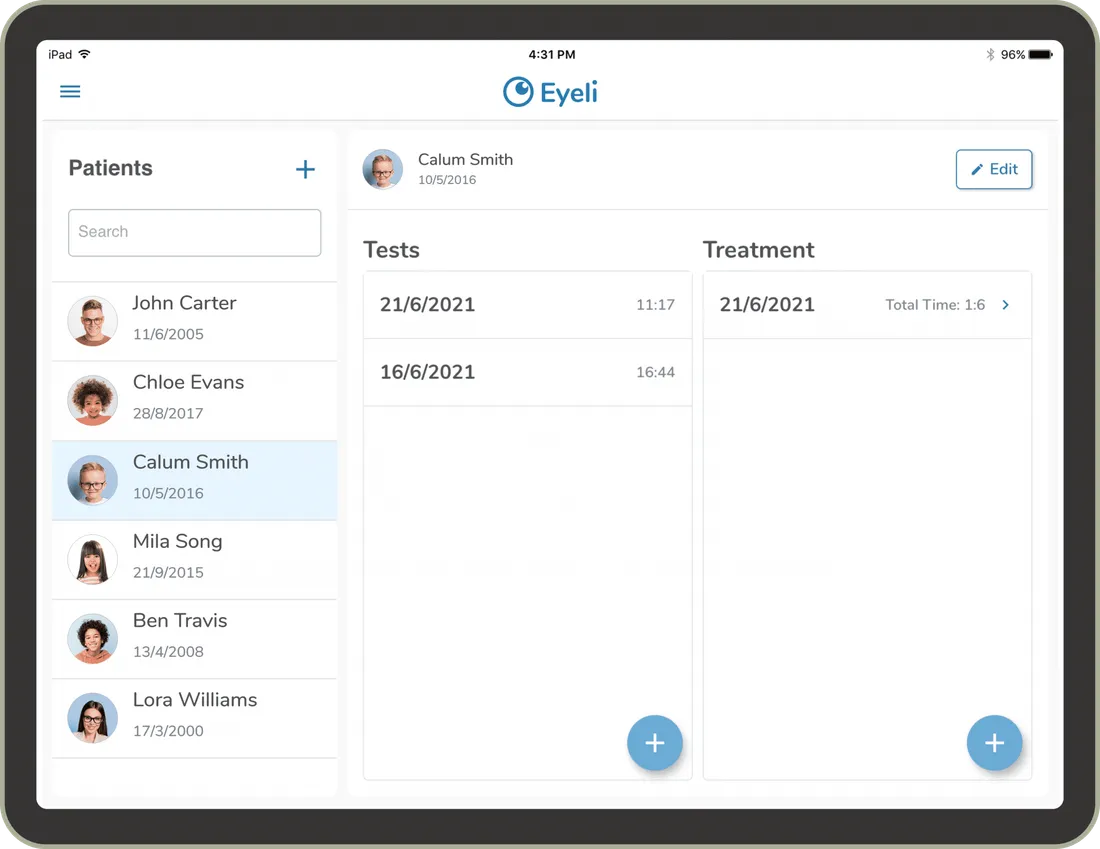
Run built-in digital tests that automatically calculate and capture results - covering visual acuity, colour vision, contrast sensitivity, accommodation flexibility, binocular acuity, stereo acuity, phoria, fixation disparity, and fusional reserves.

Add additional information - manual test results, notes, and attachments - directly into the patient record.

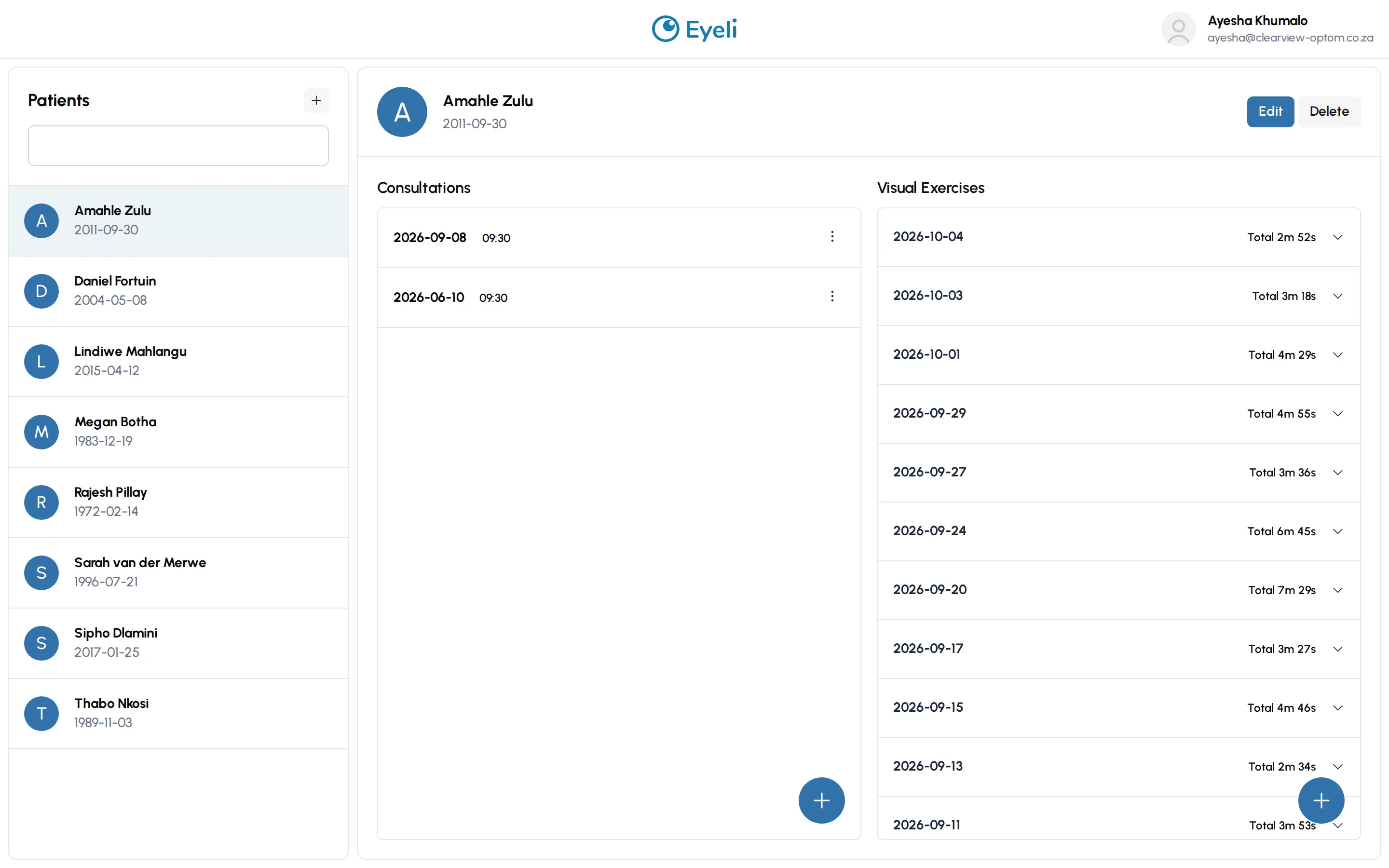
Get a detailed results overview throughout the consultation - every consultation result, additional automated calculations, the latest relevant treatment information from peer-reviewed studies, and a PDF report.

Treat binocular vision in-practice, or remotely with online visual therapy, for accommodation flexibility, eye teaming, vergence, and eye movement.

Test by test
Beyond the workflow above, see exactly what each test measures and why it matters.
01 · Binocular Test Category

What we test
With this Accommodation Flexibility test, we evaluate whether a patient can accommodate enough to see clearly at near, relax that accommodation enough to see clearly in the distance, and how quick and flexible that change in accommodation is.
Why is this important
This establishes whether a patient has an accommodation spasm, reduced accommodation reserve, or reduced accommodation facility. If the problem is limited to facility, it will affect the patient's ability to quickly and effectively copy from a board or overhead projector into a book or notes on the table.
Accommodation Exercises

Match shapes on the tablet at 40cm to shapes on a chart 3 meters away.

Match letters on the tablet at 40cm to letters on a chart 3 meters away.
02 · Binocular Test Category

What we test
We assess whether a suppression is present. When the binocular system is compromised, the brain can suppress all or part of one eye's image to eliminate double vision. By dissociating the system so both eyes stay open but do not see each other's image, we measure the smallest target size that can still be identified without fusion.
Why is this important
A suppression means the visual system is compromised and additional binocular vision testing is necessary. It can be due to amblyopia, strabismus, convergence insufficiency, anisometropia, and/or aniseikonia - and can be tracked through a therapy plan to see it reduce or resolve.

What we test
We measure the smallest difference in depth that can be detected, in seconds of arc. Two eyes working together with perfect coordination are required to perceive depth, or three-dimensional vision.
Why is this important
Reduced stereo acuity is a sign of underlying binocular issues, even in the absence of suppression, from causes like anisometropia, phoria, and/or reduced fusional ranges. A very small acuity threshold indicates good coordination between the two eyes.
Eye Teaming Exercises

Wearing red-green anaglyphs, pop as many bubbles as possible before they disappear.

Wearing red-green anaglyphs, match tiles according to shape or number.
03 · Binocular Test Category

What we test
The fusion compulsive reflex aligns our eyes so images of the object we're looking at fall on corresponding retinal points. When a phoria is present, this reflex is inaccurate and the visual system needs feedback from the other eye - plus the fusional reserves - to achieve alignment. We measure the amount of prism needed to align the images from the patient's two eyes.
Why is this important
When a phoria is present, alignment is still achievable, but at the cost of effort from the fusional reserves. It's important to also assess fixation disparity and fusional reserves to see how well the phoria is compensated, and at what cost.

What we test
If a phoria isn't completely compensated, we can measure the uncompensated residual deviation. With binocular feedback, the actual distance between the two images (seen close enough together to look single) is the Fixation Disparity - the Associated Phoria measures the same thing in prism.
Why is this important
When a Fixation Disparity or Associated Phoria is present, the visual system is really struggling to hold single vision. Alongside eye exercises, prism is recommended depending on the degree of the issue.

What we test
The fusional reserves (convergence and divergence) assist in maintaining binocular single vision. If a phoria is present, they help achieve fusion to compensate for it. This test measures how much reserve is left after that compensation.
Why is this important
Reduced fusional reserves mean the visual system has to work hard to hold single vision, even if alignment is still possible - which can lead to fatigue, eye strain, and even the onset of visual problems like myopia.
Eye Alignment Exercises

Guided convergence and divergence training to build fusional reserve capacity.

Targeted vergence exercises using binocular targets to reduce residual fixation disparity.
04 · Binocular Test Category
What we calculate
The Accommodative Convergence to Accommodation Ratio is calculated using the working distance at near and far, the pupillary distance at those distances, the vergence demand, and the accommodation demand.
Why is this important
This ratio tells us how many diopters of convergence are needed for every diopter of accommodation - in other words, how eye posture is affected as accommodative demand changes. A high AC/A ratio means the patient over-converges relative to demand; a low ratio means they under-converge.
Start free, no credit card needed - upgrade whenever your practice is ready.